


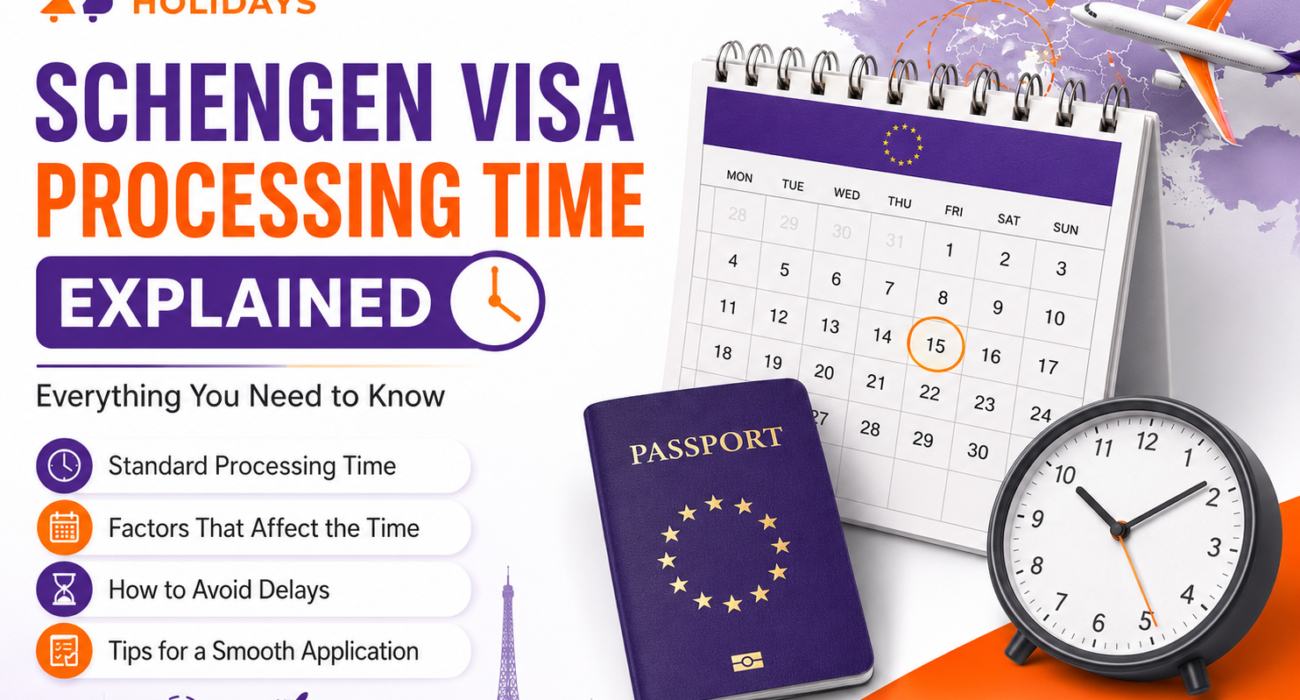
A complete, up-to-date guide to timelines, country differences, common delays, and expert tips to get your visa approved faster.
Planning a trip to Europe is exciting — but navigating the Schengen visa process can feel overwhelming, especially when you are unsure how long it will take. Whether you are applying for a tourism visa, a business trip, or a family visit, understanding the Schengen visa processing time is critical to planning your journey without stress.
This guide breaks down everything you need to know — from standard timelines and country-specific differences to the key factors that can slow down or speed up your application.
Standard Schengen visa processing takes 15 calendar days from the date your application is accepted. It can extend to 30 or 60 days in complex cases. Always apply at least 6 to 8 weeks before your travel date.
1. What Is the Schengen Zone?
The Schengen Area is a group of 29 European countries that have abolished internal border controls, allowing travelers to move freely across member states with a single visa. It is one of the largest free-travel zones in the world.
A Schengen visa is a short-stay visa that allows you to stay in the Schengen Area for up to 90 days within any 180-day period. It covers tourism, business visits, family stays, medical visits, and transit.
Schengen Member Countries (2026)
The 29 Schengen member states include Austria, Belgium, Croatia, Czech Republic, Denmark, Estonia, Finland, France, Germany, Greece, Hungary, Iceland, Italy, Latvia, Liechtenstein, Lithuania, Luxembourg, Malta, Netherlands, Norway, Poland, Portugal, Romania, Slovakia, Slovenia, Spain, Sweden, and Switzerland.
You must apply at the consulate of the country that is your main destination — or, if you are visiting multiple countries equally, the country of first entry.
2. Standard Schengen Visa Processing Time
According to the Schengen Visa Code, consulates are legally required to process applications within defined timeframes. Here is how the official timeline breaks down:
| Processing Type | Timeframe | When It Applies |
|---|---|---|
| Standard Processing | 15 calendar days | Most straightforward applications |
| Extended Processing | Up to 30 calendar days | Applications requiring further examination |
| Exceptional Processing | Up to 60 calendar days | Complex cases, additional documentation needed |
| Urgent / Emergency | 2 to 5 business days | Medical emergency, unexpected travel, limited availability |
Processing time begins only after your application is officially accepted at the consulate or visa application center — not the date you submitted it online or booked an appointment.

How Early Can You Apply?
You are permitted to submit your Schengen visa application up to 6 months before your intended travel date. However, the earliest practical window is around 3 months in advance, and the recommended minimum is 6 to 8 weeks before departure to allow sufficient buffer time.
3. Country-Wise Processing Time Comparison
While the legal maximum is 15 days, real-world processing times vary significantly between consulates. High-demand countries and busy seasons can extend timelines considerably. Below is a practical overview based on 2025–2026 applicant experiences:
| Country | Average Processing Time | Appointment Wait | Difficulty |
|---|---|---|---|
| Germany | 5 – 10 days | 2 – 6 weeks | Easy |
| France | 7 – 15 days | 3 – 8 weeks | Easy |
| Spain | 10 – 20 days | 4 – 10 weeks | Moderate |
| Italy | 10 – 25 days | 4 – 12 weeks | Moderate |
| Netherlands | 5 – 12 days | 2 – 5 weeks | Easy |
| Greece | 10 – 20 days | 4 – 8 weeks | Moderate |
| Switzerland | 5 – 10 days | 2 – 4 weeks | Easy |
| Poland | 7 – 14 days | 1 – 3 weeks | Easy |
| Sweden | 8 – 15 days | 2 – 6 weeks | Moderate |
| Portugal | 15 – 30 days | 6 – 14 weeks | Slow |
During summer (June–August) and major holidays, appointment slots and processing times at top destinations like France, Spain, and Italy can double or triple. Book your appointment as early as possible.
4. Factors That Affect Schengen Visa Processing Time
Not all applications are processed at the same speed. Several variables can either speed up or significantly delay your visa decision.
Factors That Can Delay Your Application
Incomplete or Incorrect Documentation
Missing documents, incorrect forms, unclear photographs, or unsigned pages are among the most common reasons for delays. A single missing bank statement can put your file on hold for weeks.
High Application Volume at the Consulate
Popular destinations like France, Spain, and Italy receive tens of thousands of applications monthly. During peak travel periods, even straightforward applications can take longer to process.
Additional Verification Required
If the consulate needs to verify your employment, accommodation bookings, or travel insurance, processing is paused until responses are received from third parties.
Previous Visa Refusals or Overstays
Applicants with a history of visa refusals, immigration violations, or prior overstays are subject to much more rigorous scrutiny, which naturally extends processing times.
Security or Background Checks
Depending on your nationality and travel history, some applications are referred for security screenings that take additional time.
Factors That Can Speed Up Processing
Applying via a Trusted Traveler or Frequent Flyer Program
Some consulates offer expedited processing for repeat applicants with a clean travel history and multiple prior Schengen entries.
Complete and Well-Organised Application
A thoroughly prepared application — with all documents clearly labelled and arranged in the required order — moves through the review process significantly faster.
Applying Early in the Season
Applications submitted in January, February, or early March are processed faster than those submitted in May or June, when demand spikes sharply.

5. Step-by-Step: How to Apply for a Schengen Visa
Determine the Right Consulate
Apply at the consulate of your main destination country. If you are visiting multiple countries, apply at the embassy of the country where you will spend the most days, or your first point of entry if stays are equal.
Book Your Visa Appointment
Schedule your appointment as early as possible — ideally 3 months in advance. Most consulates work through VFS Global, TLScontact, or their own official portals. Appointment slots fill up fast, especially for France, Spain, and Italy.
Gather Your Documents
Compile all required documents according to the specific consulate’s checklist. Ensure everything is correctly translated, notarised (where required), and arranged in the right order.
Fill Out the Application Form
Complete the Schengen Visa Application Form accurately. Any inconsistency between your form and supporting documents is a red flag and can lead to refusal.
Attend Your Appointment and Submit Biometrics
Attend your appointment in person. You will need to provide biometric data (fingerprints and a digital photo) if you have not done so within the last 59 months.
Pay the Visa Fee
The standard Schengen visa application fee is €90 for adults and €45 for children aged 6–12. Children under 6 are exempt. This fee is non-refundable even if the visa is refused.
Track Your Application and Collect Your Passport
Use the tracking portal provided by the visa application center. Once a decision is made, your passport will be returned with the visa sticker, or a refusal notice with the stated reason.
6. Required Documents Checklist
While exact requirements vary slightly by country, the following is a comprehensive checklist of documents required for a standard Schengen tourist visa:
- Valid passport (must be valid for at least 3 months beyond your intended stay, with 2 blank pages)
- Completed and signed Schengen Visa Application Form
- Recent passport-size photographs (taken within the last 6 months, white background)
- Round-trip flight reservation or confirmed itinerary
- Confirmed hotel bookings or invitation letter from a host
- Travel insurance covering the entire Schengen zone (minimum €30,000 medical coverage)
- Bank statements for the last 3 to 6 months showing sufficient funds
- Proof of employment (employment letter, payslips, or business registration)
- Leave approval letter from employer (if employed)
- Income tax returns (last 2 to 3 years, where applicable)
- Proof of accommodation for the entire stay
- Civil status documents (marriage certificate, birth certificate, if applicable)
- Previous Schengen visas, if any (to show travel history)
- Visa fee payment receipt
Organise your documents in the exact order listed on the consulate’s official checklist. Create a cover sheet listing every document included. This simple step makes a strong first impression and speeds up the review process.
7. Pro Tips to Avoid Delays and Get Your Visa Faster
Apply as Early as Legally Allowed
You may apply up to 6 months before travel. Take advantage of this window, especially if you are travelling in summer or during school holidays, when demand peaks sharply across all major Schengen consulates.
Apply at the Right Consulate
Applying at the wrong consulate is an instant rejection. Double-check which country qualifies as your main destination based on number of nights, not just the entry point.
Buy Travel Insurance Before Applying
Do not wait until the last moment to purchase travel insurance. You need the policy in hand when you submit your application. Make sure it explicitly states coverage across all Schengen countries, not just your main destination.
Maintain Consistent Documentation
Your travel dates on the application form, flight bookings, hotel bookings, and insurance policy must all match exactly. Any inconsistency raises a red flag and triggers manual review.
Show Strong Ties to Your Home Country
Consulate officers want assurance that you will return home. Include evidence of employment, property ownership, family ties, business operations, or financial obligations in your home country.
Track Your Application Regularly
Check your application status through the official VFS or TLScontact tracking portal. If you are asked to provide additional documents, respond immediately — delays on your end pause the entire process.
Wait until your visa is approved before paying for non-refundable flights or hotel bookings. Use flexible, refundable reservations or visa-friendly booking options during the application period.

8. Frequently Asked Questions
How long does a Schengen visa take to process?
Standard processing takes 15 calendar days from the date your application is accepted. This can extend to 30 or 60 days in more complex cases. Urgent applications can be processed in as few as 2 to 5 business days, subject to eligibility.
When should I apply for a Schengen visa?
You can apply up to 6 months before your travel date. It is strongly recommended to apply at least 6 to 8 weeks in advance to account for appointment availability and processing time, particularly during peak travel seasons.
Which Schengen country processes visas the fastest?
Germany, the Netherlands, Switzerland, and Poland are generally known for faster, more efficient processing — often completing applications within 5 to 10 working days. Countries like Portugal and Italy tend to take longer due to higher demand and administrative load.
Can I track my Schengen visa application status?
Yes. Most visa application centers, including VFS Global and TLScontact, provide online tracking tools. You can monitor your application status using your reference number on their official websites.
What happens if my Schengen visa is refused?
You will receive a formal refusal notice stating the reason. You have the right to appeal within the timeframe specified in the notice. Alternatively, you can reapply with a stronger application addressing the reason for refusal.
Can I apply for a Schengen visa online?
A limited number of consulates are piloting digital or e-visa applications, but most still require a physical appointment for biometric collection. Check the official website of the relevant consulate for the latest process in your country.
Is the Schengen visa fee refundable if refused?
No. The Schengen visa application fee of €90 is non-refundable regardless of the outcome. This is a standard policy across all member states.

Ready to Start Your Schengen Visa Application?
Use our complete guides, checklists, and country-specific tips to prepare a strong application and avoid common mistakes that lead to delays or refusals.