
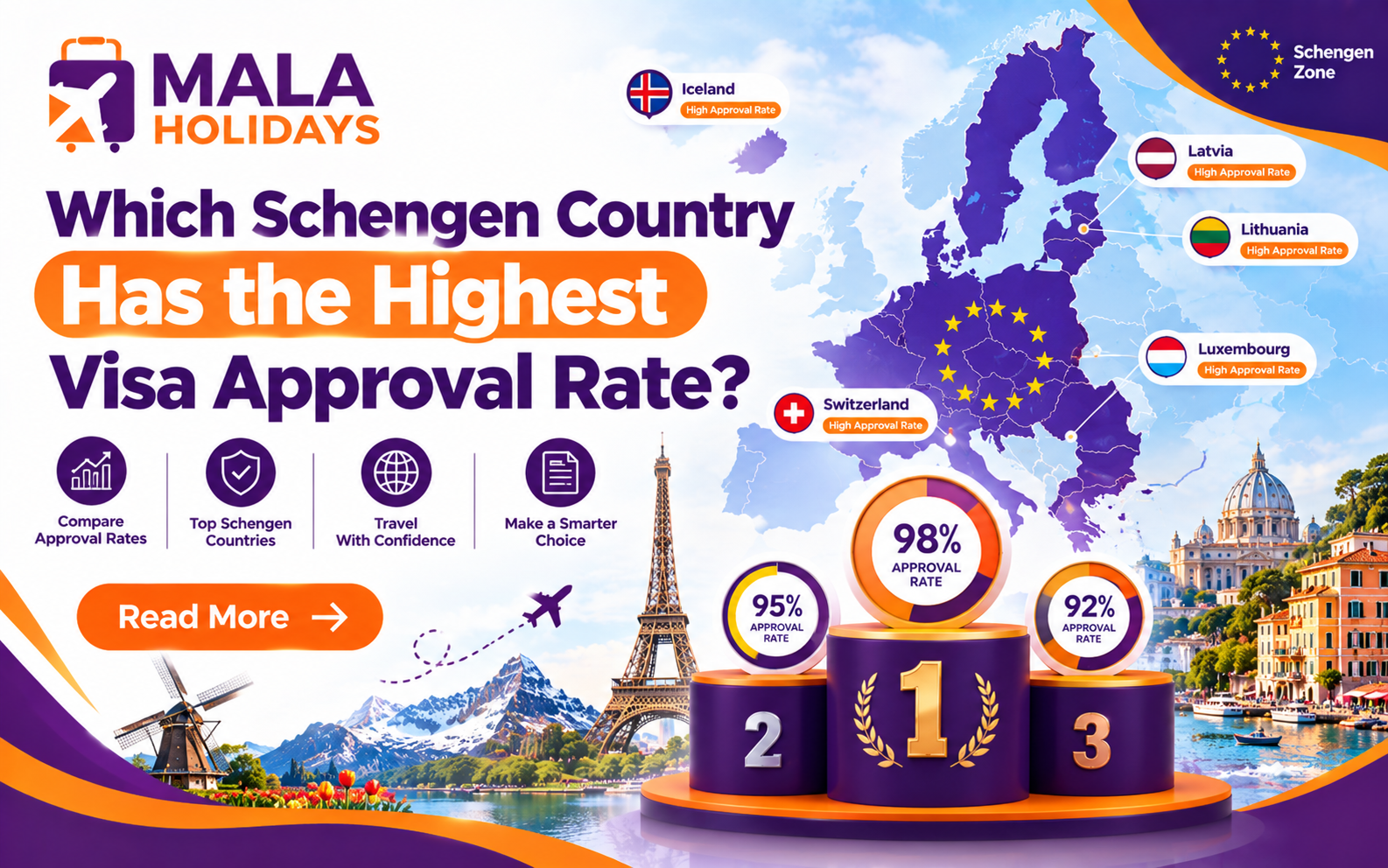
If you are planning a European holiday and need a Schengen visa, you may be wondering which country has the highest visa approval rate. This is a common question among travellers who want to understand their chances of receiving a visa before submitting an application.
However, a high approval rate does not mean that applicants can simply choose that country to increase their chances. Schengen visa applications must normally be submitted to the country that is your main destination.
Which Schengen Country Has the Highest Visa Approval Rate?
Based on 2025 Schengen visa statistics, Slovakia had the lowest overall refusal rate among the Schengen states listed in the available country-level comparisons, at approximately 9.6%. This corresponds to an approval rate of around 90.4%.
Italy was also among the countries with the lowest refusal rates, with approximately 10.8% of applications refused in 2025. That represents an approval rate of around 89.2%.
| Schengen Country | Approx. Refusal Rate | Approx. Approval Rate |
|---|---|---|
| Slovakia | 9.6% | 90.4% |
| Italy | 10.8% | 89.2% |
| Romania | 11.5% | 88.5% |
| Austria | 11.9% | 88.1% |
| Switzerland | 12.5% | 87.5% |
| Germany | 13.1% | 86.9% |
These figures are based on applications processed at consulates worldwide. They should be treated as historical statistics rather than a prediction of an individual applicant’s result.
What Was the Overall Schengen Visa Approval Rate in 2025?
In 2025, Schengen countries received more than 12 million short-stay visa applications. More than 10 million visas were issued, while the overall refusal rate was approximately 14.6%.
The European Commission reported that demand for Schengen visas increased in 2025 compared with 2024. The statistics cover applications processed by Schengen consulates and provide useful information about visa trends across different destinations.
Top Schengen Countries by Visa Approval Rate
While approval rates vary from year to year, several countries recorded relatively low refusal rates in 2025. The following destinations were among the better-performing Schengen states based on overall country-level statistics:
1. Slovakia
Slovakia recorded an estimated approval rate of around 90.4% in 2025, based on an approximately 9.6% refusal rate. This places Slovakia at the top of many country-level comparisons for that year.
Nevertheless, applicants should only apply to Slovakia when Slovakia is genuinely their main destination during the planned trip.
2. Italy
Italy processed more than one million Schengen visa applications in 2025 and recorded a refusal rate of approximately 10.8%. This translates into an approval rate of around 89.2%.
Italy is also one of the most popular Schengen destinations, particularly for tourism, family holidays and cultural trips.
3. Romania
Romania recorded a refusal rate of approximately 11.5% in 2025, giving it an estimated approval rate of around 88.5%.
4. Austria
Austria had a refusal rate of approximately 11.9% in 2025, equivalent to an estimated approval rate of around 88.1%.
5. Switzerland
Switzerland also performed relatively strongly, with an estimated approval rate of approximately 87.5% based on its reported refusal rate of about 12.5%.
Does a High Approval Rate Mean It Is Easier to Get a Visa?
Not necessarily. A country’s overall approval rate is based on all applications processed by its consulates and can be influenced by the nationality, location, travel purpose and circumstances of applicants.
For example, one consulate may receive applications from a different mix of travellers than another. Therefore, a country’s global approval percentage does not tell you exactly what your personal chances of approval will be.
Your application will be assessed according to the applicable Schengen visa rules and the evidence you provide, including your travel plans, financial circumstances and intention to leave the Schengen Area before your visa expires.
Can You Apply to the Schengen Country With the Highest Approval Rate?
No. You should not select a Schengen country simply because its historical approval rate is higher.
The general rule is that you should apply to the Schengen country that is your main destination. This is normally the country where you intend to spend the most time during your trip.
If you are spending an equal amount of time in several Schengen countries and there is no main destination, the application is generally made to the country you will enter first.
Example: Choosing the Correct Schengen Country
Suppose you are planning a 10-day European holiday:
- 5 nights in Italy
- 3 nights in France
- 2 nights in Switzerland
Italy is your main destination because you are spending the largest number of nights there. You should therefore normally apply for your Schengen visa through Italy rather than choosing another country because it has a higher historical approval rate.
What Factors Affect Schengen Visa Approval?
Historical approval statistics are only one part of the picture. Your individual application is much more important.
1. Genuine Travel Purpose
Your application should clearly explain why you are travelling, where you will stay and what you plan to do during your visit.
2. Financial Evidence
Applicants generally need to demonstrate that they have sufficient funds for their planned trip and can cover accommodation, transportation and other expenses.
3. Strong Evidence of Your Circumstances
Documents relating to employment, business, family responsibilities, residence and other commitments can help demonstrate your circumstances and intention to return.
4. Consistent Documentation
Information across your application form, bank statements, employment documents, hotel bookings and travel itinerary should be consistent and credible.
5. Previous Travel History
Previous international travel can be relevant when assessing an application, particularly where the applicant has complied with the conditions of previous visas. However, having limited travel history does not automatically mean that an application will be refused.
What About Schengen Visa Applications From the UK?
If you live in the UK and need a Schengen visa, the correct application procedure depends partly on your nationality and residence status.
British citizens generally do not need a Schengen visa for short tourist visits of up to 90 days in any 180-day period. However, UK residents who are citizens of countries whose nationals require a Schengen visa may need to apply for one before travelling.
UK residents should also check the jurisdiction of the relevant consulate or visa application centre before submitting an application.
Is Slovakia the Easiest Schengen Country to Get a Visa From?
It would be misleading to describe Slovakia as the “easiest” Schengen country simply because its 2025 overall refusal rate was low.
The statistics show what happened to applications processed in a particular year. They do not guarantee that a future applicant will receive a visa, and they should not be used as a reason to create an artificial itinerary.
The safest approach is to identify your genuine main destination and prepare a complete, accurate and well-supported application.
How to Improve Your Schengen Visa Application
If you are applying for a Schengen visa, consider the following practical steps:
- Choose the correct Schengen country based on your actual itinerary.
- Complete the application form accurately.
- Provide a clear travel itinerary.
- Show suitable accommodation arrangements.
- Provide appropriate financial evidence.
- Include employment or business documents where relevant.
- Make sure your supporting documents are consistent.
- Provide travel insurance that meets the applicable requirements.
- Attend your appointment and provide biometrics where required.
- Check the latest requirements before submitting your application.
Frequently Asked Questions
Which Schengen country has the highest visa approval rate?
Based on 2025 country-level statistics, Slovakia recorded one of the lowest refusal rates at approximately 9.6%, corresponding to an approval rate of about 90.4%. However, this does not mean that Slovakia is automatically easier for every applicant.
Is Italy a good country to apply for a Schengen visa?
Italy recorded a relatively low refusal rate in 2025. However, you should apply to Italy only when Italy is your genuine main destination under the Schengen visa rules.
Can I apply to Slovakia because it has a high approval rate?
No. You should normally apply to the country that is your main destination. Applying through another country simply because its statistics appear more favourable can create problems if your itinerary does not support the application.
Does a high Schengen approval rate guarantee my visa?
No. Country-level statistics are historical averages. Your application is assessed individually, and the quality and credibility of your documents and circumstances remain important.
What was the overall Schengen visa refusal rate in 2025?
The European Commission reported an overall refusal rate of approximately 14.6% for Schengen short-stay visa applications in 2025.
Final Thoughts
Slovakia had the highest estimated approval rate among the leading country-level Schengen comparisons for 2025, at approximately 90.4%. Italy, Romania, Austria and Switzerland also recorded relatively low refusal rates.
However, the most important point for applicants is that you cannot legally choose a Schengen country simply because it has a higher approval rate. Your application should normally be submitted to the country that represents your main destination.
Rather than focusing only on approval statistics, concentrate on presenting a genuine travel plan, sufficient funds, appropriate accommodation, consistent documentation and clear evidence supporting your circumstances.